
Model · speech-to-text
Parakeet TDT 0.6B v2: English–Hebrew code-switching
Speech-to-text that gets the Hebrew words right when an English speaker in Israel drops them into English: "pick up some bamba from the makolet".
What it fixes
I want to go to the Micollette today to buy my groceries.
I want to go to the makolet today to buy my groceries.
About the model
Stock Parakeet v2 is very good at English, but it has never seen romanized Hebrew. A Hebrew word in English speech comes out as whatever English words sound closest. The v2 tokenizer has no Hebrew characters, so this fine-tune teaches the model one romanized spelling for each Hebrew word.
It was trained on read-aloud sentences that I recorded on the Android phone that runs the model, plus some plain English so that it keeps its English. It runs fully offline on a phone or a Linux desktop.
This is release v2 of the fine-tune (2026-10-15), trained from stock Parakeet v2 on 120 minutes of code-switched speech.
I chose v2 over Parakeet v3 on purpose. In my own dictation v2 was more accurate for English; v3 adds 25 languages and gives up some English accuracy.
Which file should I download?
If unsure, take Q8_0. On desktop CPUs it was also faster than Q4_K_M (about 3× realtime against 1.4× on 8 cores), and both gave the same transcripts as the full model on the test clips.
GGUF Q8_0 730 MB
Android phone or Linux desktop. Take this one if unsure.
Run with Offline Voice Input (Android) / Handy (Linux) Download GGUF Q8_0 →GGUF Q4_K_M 475 MB
Phones with 4 GB of RAM or less, or if Q8_0 is too slow.
Run with Offline Voice Input Download GGUF Q4_K_M →.nemo checkpoint 2.47 GB
Python, GPU inference or further fine-tuning, at full precision.
Run with NVIDIA NeMo Download .nemo checkpoint →On Android
- Install Offline Voice Input (source), download the Q8_0 GGUF on the phone, import it in the app and select it.
- Use it as the system voice input, or through a keyboard whose mic key opens it: SwiftKey, HeliBoard or FlorisBoard. Gboard's mic button cannot hand speech to it.
- Set the app's battery optimisation to Unrestricted so Android does not kill it between dictations.
On Linux
- Handy loads the same GGUF. Copy it into
~/.local/share/com.pais.handy/models/under its own file name.
Results
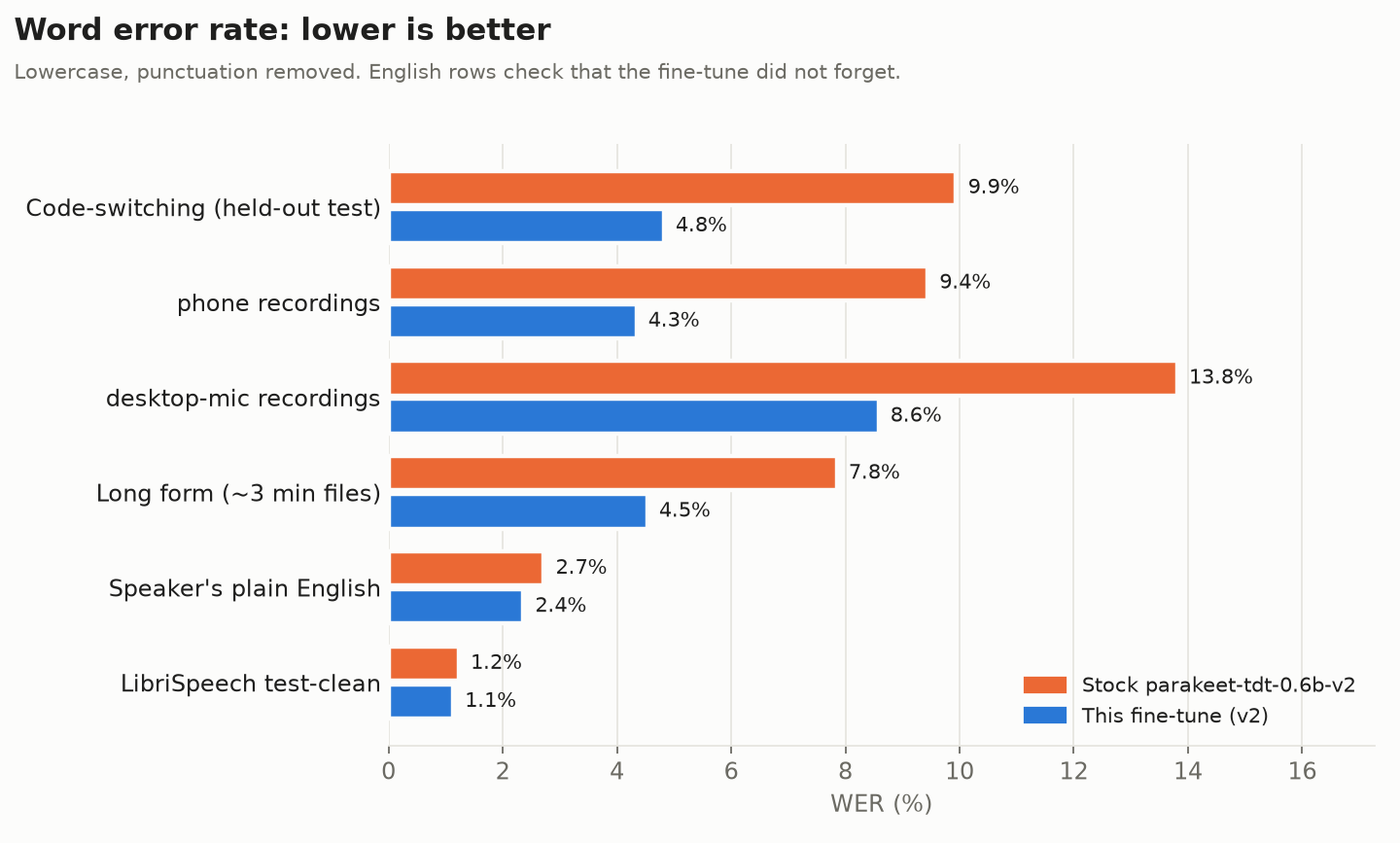
v1, run r2-en30, evaluated 15 October 2026. Lower WER is better; a higher share of terms correct is better.
| Test set | Stock v2 | Fine-tune |
|---|---|---|
| Code-switching, held-out test split, 121 clips (WER) | 9.9% | 4.8% |
| Code-switching test, phone recordings only (WER) | 9.4% | 4.3% |
| Code-switching test, desktop-mic recordings only (WER) | 13.8% | 8.6% |
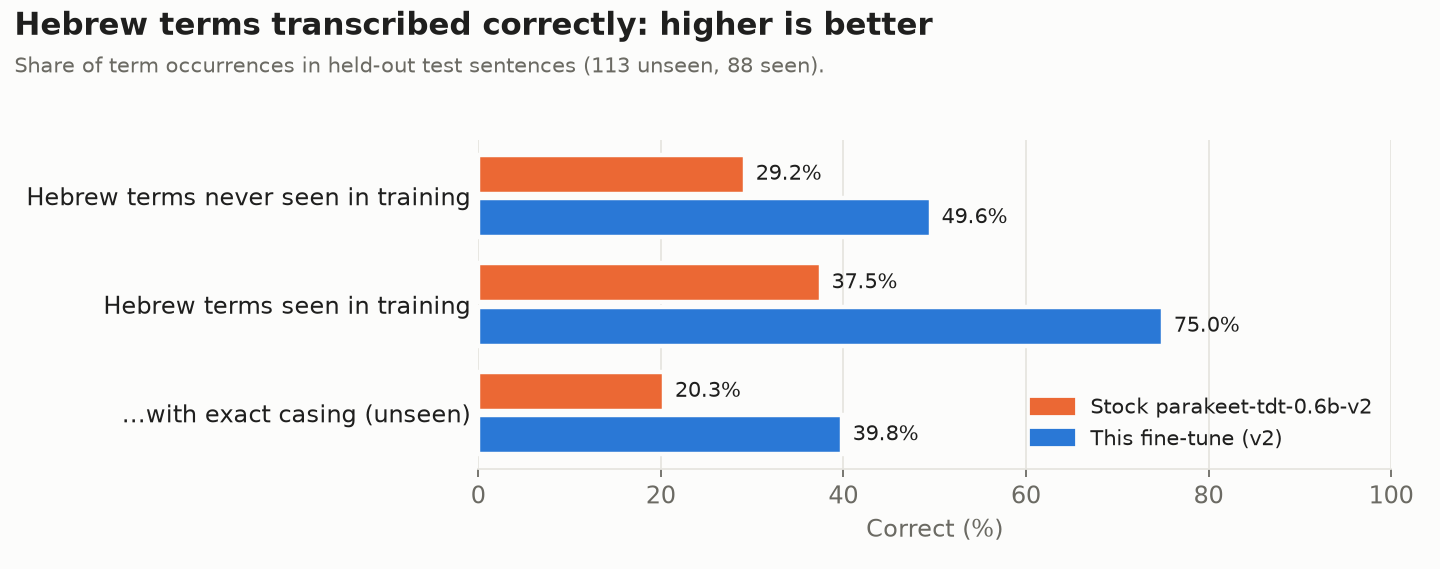
| Hebrew terms never seen in training: share correct | 29% | 50% |
| Hebrew terms seen in training, in test sentences: share correct | 38% | 75% |
| Speaker's own plain English (WER) | 2.7% | 2.4% |
| LibriSpeech test-clean, 200 utterances (WER) | 1.2% | 1.1% |
| Long form, 5 files of ~3 minutes (WER) | 7.8% | 4.5% |
- WER is lowercase with punctuation removed. Both models used the same NeMo harness (bf16, greedy decoding).
- The test split is term-disjoint: about 1 Hebrew term in 12 is held out of training entirely, and the "never seen" row scores only those terms.
- v1 (earlier on 2026-10-15) scored 9.5% → 4.5% WER and 30% → 55% on unseen terms, but on the older 85-clip test split, so its figures are not directly comparable with these.
- English did not get worse. The jump on unseen terms suggests the model learned how this speaker's Hebrew maps to the romanization, not only the training words.
- Against other models: on my English–Hebrew code-switching ASR benchmark (test set v1, 84 clips no model trained on, 2026-10-15), release 2 of the fine-tune (built on Parakeet v2) gets 65.7% of Hebrew words right, ahead of Whisper-Hebrish (54.1%), Whisper Large V3 (45.9%), Whisper Large V3 Turbo (40.1%) and stock Parakeet v2 (32.6%). See the leaderboard and write-up linked below.
Training
- 120 min of code-switched speech (1,248 clips: phone recordings plus an earlier desktop-mic set).
- 29 min of the speaker's own monolingual English and 17 min of LibriSpeech-PC replay, so about 72% code-switching and 28% English. Fine-tuning on code-switched speech alone is known to damage a model's English.
- Full fine-tune from stock v2 (not continued from v1) in NeMo 2.7.3: AdamW, lr 3e-5, cosine schedule with 10% warmup, 20 epochs, batch 16, bf16. 23 minutes on one L40S; best checkpoint by validation WER at epoch 17. Run name r2-en30.
- Data pinned to Read-Aloud-Voice-Sentences at revision 3bdaa2a50d52.
Training data
Checkpoints and roadmap
Where the model is now and the checkpoints still to come. Planned stages are the current plan, not promises.
- Baseline Done 15 October 2026
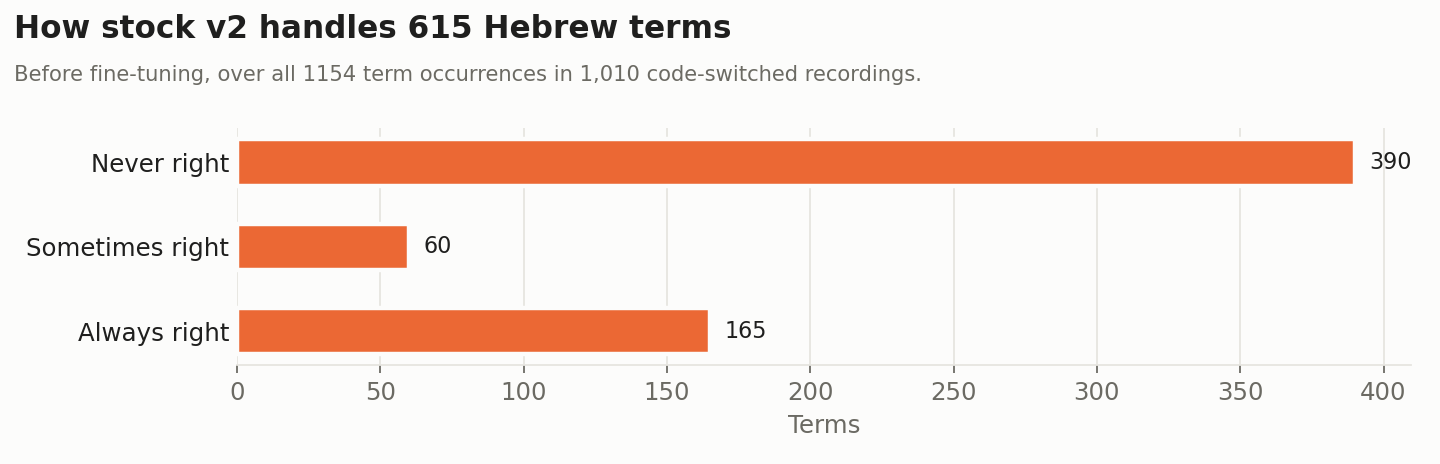
Stock v2 got 28% of Hebrew term occurrences right across 615 terms.
- v1 pilot (pilot-en30) Done 15 October 2026
First release: 77 min of code-switching, 30% English. Superseded by v2; kept in the Hugging Face repo history.
- GGUF export Done 15 October 2026
transcribe.cpp v0.1.3; identical transcripts to PyTorch on 5 test clips.
- v2 retrain (r2-en30) Done 15 October 2026
Released: 120 min of code-switching, 28% English, trained from stock v2. Same files and download links; .nemo plus GGUF Q8_0 and Q4_K_M.
- Data collection In progress
Recording continues, weighted toward the terms v2 still gets wrong.
- v3 at 180 min Planned
Retrain at 180 min of code-switching audio, comparing 0%, 15% and 30% English and keeping the mix that does best on both code-switching and general English.
- On-phone test Planned
Measure accuracy and speed of the GGUFs on the target phone.
- ONNX export Planned
For sherpa-onnx apps such as Voxtype and Dictus.
Limitations
- One speaker: an English speaker with an Irish accent living in Jerusalem. Gains on other voices are untested.
- About 2 hours of code-switched audio, with most Hebrew terms recorded only once or twice. Unseen terms are still right only about half the time.
- Spellings follow one convention (the Hebrew-Latin-Token-Classifier lexicon), so the model may prefer it over other romanizations.
- On-device accuracy and phone speed are not measured yet beyond a five-clip GGUF check.
Related
- Project tracker (GitHub)Status, lifecycle, results and log
- Demo SpaceStock v2 and the fine-tune side by side
- Benchmark leaderboardThis model against stock Whisper, Parakeet and Whisper-Hebrish on the same frozen test set
- Benchmark write-up (blog)"Can speech-to-text spell makolet?": what the benchmark measures, what it caught, and the results
- Offline Voice InputAndroid voice keyboard that loads the GGUF
- HandyLinux desktop dictation; loads the same GGUF
- Hebrew-Latin token classifierIts lexicon sets the spelling of every Hebrew word
- Whisper HebrishThe earlier Whisper fine-tune for the same problem